
AI's Identity Crisis
Corporations Are People, But Are Computers?


I write about my former colleague Alex Campbell’s writing a lot. At this point, you should probably just go subscribe to him. In his recent piece, on technology companies becoming banks, he said something that shifted how I’m thinking about the AI challenge to the economy.

He writes:
To operate in the world of dollars you need identity. KYC, “know your customer,” is the price of admission to every regulated financial market on earth. Property rights, contract enforcement, legal standing, all of it assumes there’s a person on the other end of the wire. Dollar-denominated finance runs on verified human identities, all the way from the Fed wire down to your mortgage lender.
The regulatory stack enforcing this:
Bank Secrecy Act / AML: KYC for every US financial institution
Dodd-Frank: systemic risk oversight
PSD2/PSD3 (EU): open banking, payment services regulation
Basel III/IV: bank capital requirements globally
State money transmitter licenses: what X, PayPal, and every fintech hold to move dollars. The first step on the payment processor to bank rails pipeline
Meanwhile the digital identity infrastructure is getting more robust, not less:
EU eIDAS 2.0: digital identity wallets across the EU
India Aadhaar: 1.4 billion biometric IDs, backbone of UPI
Mastercard: replacing card numbers with tokenized biometric identity by 2030
Worldcoin/World ID: biometric iris-scanning UUID at global scale
This is where my other rant from 2023 comes in, “How to Regulate AI.”
While doomers were panicking about parameter counts. My argument was simple: until machines become legal persons, liability flows back to the humans who set them in motion. The real regulatory infrastructure is personhood, not compute caps.
The proliferation of AI ‘agents’ makes it more salient. As agents proliferate, “is this a human?” becomes the most valuable question in finance. The more capable the machines get, the higher the walls around human-verified financial infrastructure need to be. The more you need to really know it’s a human on the other end of the line.
And what this means for the financial system.
The World of Dollars is where humans live. KYC-governed, nation-state regulated, court-enforced. Where the big assets sit:
Global real estate: $393 trillion (Savills 2025), ~4x global GDP
Global bond markets: ~$130 trillion
Global equities: ~$100-115 trillion
All the gold ever mined: ~$20 trillion
The descendant of that 17th-century English estate deed that Morgan’s founding partner threw into the pot. Still almost entirely off-chain. Almost entirely human.
The World of Crypto is where machines can play. Total market cap ~$2.4 trillion. About 0.6% the value of global real estate in what’s called “Real World Asset” linked crypto. But the market cap understates the infrastructure. Crypto rails offer machine-speed settlement, micropayments, programmable transactions, and operation without identity verification at the base layer. An AI agent can hold a wallet, sign a transaction, and settle in seconds. No KYC required.
This isn’t theoretical. The agent financial infrastructure is being built now:
Coinbase Agentic Wallets (Feb 2026): first wallet infrastructure for AI agents. Autonomous spending, earning, trading. Deployed via CLI in under 2 minutes.
x402 protocol (Coinbase + Cloudflare): machine-to-machine payments standard. 50M+ transactions. Named after the HTTP 402 “Payment Required” status code that was planned but never implemented. Now it is.
MoonPay Agents (Feb 2026): non-custodial AI wallets, automated trading and fiat on-ramps
Stripe: x402 support for USDC-based agent payments
Coinbase Payments MCP: letting LLMs like Claude and Gemini access blockchain wallets directly
What agents are doing with the money: monitoring DeFi yield rates and rebalancing at 3am. Paying for compute per-request via stablecoins. Negotiating agent-to-agent data purchases in 200-millisecond cycles. Theoriq Alpha Vault runs $25 million in TVL managed entirely by autonomous systems.
AI is bullish for crypto because autonomous agents need a financial system that doesn’t require them to be human. The dollar system demands identity. Crypto doesn’t. Billions of agents executing billions of microtransactions need permissionless rails. There is no alternative. For now.
Stablecoins are the bridge.
USDC is already the settlement layer for Coinbase agent wallets and Visa’s network, which supports over 130 stablecoin-linked card programs in 40+ countries. The GENIUS Act, signed July 2025, let US banks issue their own stablecoins. Forecasts have the market at $500 billion this year, $2-4 trillion by 2030.
So the machine-native financial layer is real and growing fast. But the vast majority of valuable assets remain off-chain. $393 trillion in real estate. Trillions more in private equity, infrastructure, sovereign debt. All under legal frameworks requiring human counterparties, governed by courts that only recognize legal persons. An AI agent can trade an ERC-20 token in milliseconds. It cannot buy a house. It cannot enforce a contract in Delaware Chancery Court.
This reminds me of how some Cayman Island citizens can get paid just for existing.
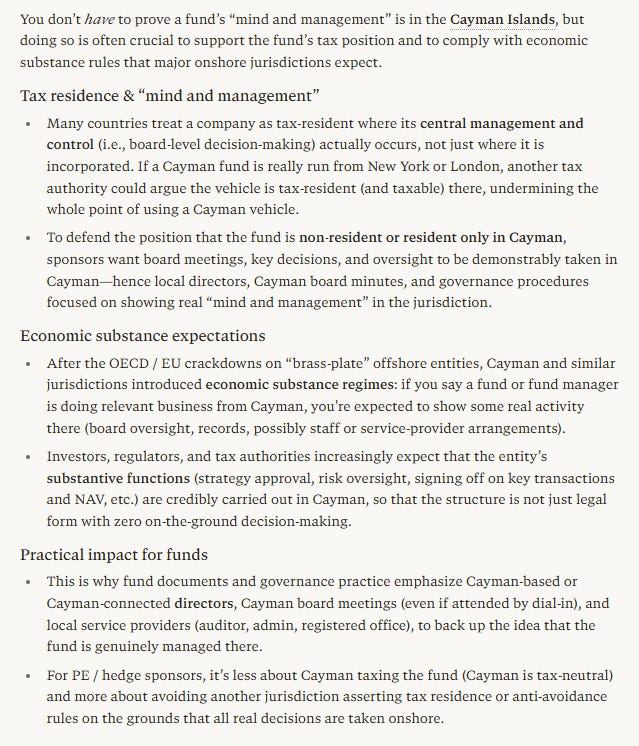
But just as a cushy, do-nothing Cayman island director gig is highly desirable to me but I have no chance of getting it, I wonder if the returns to humans that accrue from not being a machine will be widely accessible to all or will concentrate, like the returns to the commoditization of intelligence, in very few hands. AI might not be able to take over, but I still think it can take jobs.
In the future, your job choices will be limited to AI Agent Scapegoat Sacrificial Offering or Home Health Aid For Rich Retired Boomers. Study hard.
News Scan
ECB Rate Hike Goes from Fringe to Fully Priced as Energy Crisis Upends European Bonds
Source: Bloomberg
Date/Time: March 6, 2026
European bond markets have undergone a regime shift in rate expectations: traders now fully price an ECB rate hike in 2026, up from a 40% probability of a rate cut just days ago. Government debt across the euro area and UK resumed a punishing slide on Friday as the Iran war showed no sign of easing and energy prices continued to surge. This is the most dramatic repricing of ECB policy expectations since the tightening cycle began in 2022. The combination of February’s inflation upside surprise (1.9% headline, 3.4% services), record-low unemployment, and now a sustained energy supply shock has closed off any path to easing and opened the door to tightening. Bundesbank President Nagel’s “very vigilant” framing now looks like the leading edge of a hawkish consensus. The March 12 ECB meeting is set to deliver a hold with hawkish language, but markets are already pricing the next step. The ECB’s shift from potential easer to potential hiker fundamentally changes European rate differentials and EUR flows.
Bloomberg
Eurozone Q4 GDP Revised Down to +0.2% from +0.3% — Growth Weakening as ECB Faces Inflation Pressure
Source: Eurostat / Bloomberg
Date/Time: March 6, 2026
Eurostat’s final estimate for eurozone Q4 2025 GDP growth came in at +0.2% quarter-on-quarter, revised down from the +0.3% flash estimate. Annual growth was also cut from 1.3% to 1.2%. Full-year 2025 growth was revised from 1.5% to 1.4%. Among major economies, Spain led at +0.8%, the Netherlands at +0.5%, while Germany and Italy each grew +0.3% and France lagged at +0.2%. Household consumption rose +0.4%, but fixed investment growth halved (0.6% vs 1.3% prior quarter) and public spending decelerated. This downward revision sharpens the ECB’s dilemma heading into the March 12 meeting: growth is weaker than initially estimated, yet the energy shock and inflation data are pushing rate expectations toward a hike. The eurozone is entering a textbook stagflationary bind — softer growth and rising price pressures simultaneously — that leaves the ECB with no clean policy option.
Bloomberg
PBOC Governor Vows Flexible, Efficient RRR and Rate Cuts in 2026
Source: Bloomberg / Reuters
Date/Time: March 6, 2026
People’s Bank of China Governor Pan Gongsheng told reporters at the NPC Two Sessions that “there is still room for further RRR and interest rate cuts this year” and that the PBOC will deploy monetary tools “flexibly and efficiently.” He also pledged to curb “involution-style” competition in certain sectors. The statement is the monetary policy complement to yesterday’s massive fiscal expansion (RMB 12 trillion package, 4.5–5% GDP target). While the PBOC has been signaling easing since January, the NPC context gives these commitments additional institutional weight. China simultaneously cut the FX risk reserve ratio for forward sales to 0% from 20% (effective March 2), easing yuan hedging costs. The dual fiscal-monetary signal is Beijing’s attempt to front-load policy support as the economy faces both structural domestic weakness (manufacturing PMI at 49.0) and the external shock of Middle Eastern energy disruption.
Bloomberg
US Q4 Productivity Surges +2.8% but Unit Labor Costs Also Hot at +2.8% — Stagflation Signal Ahead of FOMC
Source: BLS / Reuters
Date/Time: March 6, 2026
Nonfarm business sector productivity rose 2.8% annualized in Q4 2025, well above the +1.9% consensus, as output grew 3.3% while hours worked increased only 0.5%. But unit labor costs also jumped 2.8%, above the +2.0% expected, driven by a 5.7% surge in hourly compensation. The manufacturing sector was worse: unit labor costs spiked 8.3% as productivity actually declined 1.9% while compensation rose 6.2%. The divergence creates a stagflationary signal ahead of the March 17-18 FOMC meeting: strong productivity growth suggests the supply side is performing, but the simultaneous ULC overshoot means firms are passing through higher labor costs. Combined with the ISM Services strength (56.1) and today’s nonfarm payrolls release, this data reinforces the Fed’s hold stance while raising the bar for any 2026 cut.
BLS
BOJ April Rate Hike Odds at 50/50 After Iran, Former Official Says
Source: Bloomberg
Date/Time: March 6, 2026
A former Bank of Japan official estimated that the probability of an April rate hike is now a coin flip, despite the BOJ holding at its March meeting and the Iran conflict adding uncertainty. The assessment reflects the competing forces: Governor Ueda’s clear commitment to continue raising rates and the approaching shunto wage results argue for April, while the energy shock and its deflationary impact on Japan’s trade-dependent economy argue for patience. This 50/50 framing is significant because it means the market cannot confidently price out an April hike — keeping the yen’s rate-differential pressure alive and maintaining BOJ optionality. The gating variable remains shunto results and whether they show wage increases sufficient to sustain the BOJ’s virtuous cycle thesis. Japan’s 90% dependence on Middle Eastern oil imports makes the energy channel uniquely important for the BOJ’s reaction function.
Bloomberg
US Grants India 30-Day Waiver to Buy Russian Oil as Hormuz Crisis Deepens
Source: Bloomberg / CNBC
Date/Time: March 6, 2026
The US issued a temporary license allowing Indian firms to purchase Russian crude oil and petroleum products that were loaded onto vessels before March 5, reversing months of sanctions pressure on the world’s third-largest crude importer. The waiver expires April 4 and was framed by Treasury Secretary Bessant as covering only oil “already stranded at sea” to minimize financial benefit to Russia, with the expectation that India will increase US energy imports going forward. The policy significance is threefold: (1) it is an implicit admission that the Hormuz closure is severe enough to require emergency supply measures; (2) it resets the US-India energy relationship by using sanctions relief as a diplomatic lever; and (3) it signals that Washington is prioritizing global energy stability over its Russia sanctions regime — a hierarchy that could set precedents for other importers. Crude tanker traffic through Hormuz has plunged 88% and LPG vessel traffic is down 94%, underscoring the severity of the supply disruption that prompted this reversal.
CNBC
Saudi Arabia Hikes Asian Oil Prices by Most Since August 2022
Source: Bloomberg
Date/Time: March 5, 2026
Saudi Aramco raised the official selling price (OSP) for its flagship Arab Light crude to Asian buyers for April by the largest increment since August 2022, setting it at $2.50/barrel above the Oman/Dubai average. This is a primary pricing action by the world’s largest oil exporter, reflecting the structural tightening of the physical crude market as the Hormuz closure removes an estimated 15 million barrels per day from global shipping routes. The pricing move confirms that Saudi Arabia is exploiting its market power during the supply disruption rather than absorbing the shock, which amplifies the cost-push inflation channel for Asian importers (Japan, South Korea, India, China) already dealing with inventory drawdowns. Combined with S&P Global Platts’ earlier suspension of Gulf loadings from the Dubai benchmark, the Asian crude pricing infrastructure is being fundamentally reshaped by this conflict.
Bloomberg
Turkey Spends $12 Billion — 15% of FX Reserves — to Defend Lira
Source: Bloomberg
Date/Time: March 6, 2026
Turkey’s central bank deployed $12 billion in dollar sales over the past week to keep the lira stable, burning through roughly 15% of its net foreign-currency reserves ($78.4 billion). The intervention made the lira one of the best-performing EM currencies this week (just -0.1% vs USD) while peers collapsed. Turkey is uniquely exposed to the Iran conflict due to both geographic proximity and energy import dependence, with crude prices up 16% since the war started. The scale of the intervention — dwarfing any single-week EM central bank action in recent memory — raises questions about sustainability: at this burn rate, Turkey’s reserve cushion would be depleted in roughly six weeks. The lira defense is politically motivated ahead of 2027 elections, but it comes at the cost of monetary policy flexibility and reserves that may be needed if the conflict extends further. Including gold, Turkey has ~$200 billion in total reserves, but the speed of deployment signals acute stress.
Bloomberg
London Reinsurers Scrap War-Risk Marine Cover in Persian Gulf — Premiums Surge 5x
Source: Bloomberg
Date/Time: March 6, 2026
Major London reinsurers issued seven-day cancellation notices on marine war-risk policies for the Persian Gulf, Gulf of Oman, and Iranian waters after a US submarine torpedoed an Iranian warship off Sri Lanka. Insurance clubs including Gard, Skuld, NorthStandard, the London P&I Club, and the American Club all filed cancellations effective March 5. War risk premiums surged from ~0.2% to 1% of ship value — a fivefold increase — with some quotes even higher. This is a structural market infrastructure change: without war-risk cover, commercial vessels cannot legally or financially transit the affected waters, reinforcing the de facto closure of Hormuz beyond just the military threat. The insurance pullback creates a second lock on the strait — even if military conditions eased, it would take weeks to reinstate coverage and resume normal shipping. This amplifies the supply disruption’s duration beyond the immediate conflict timeline.
Bloomberg
Emerging Market Currencies and Equities Set for Worst Week Since the Pandemic
Source: Bloomberg
Date/Time: March 6, 2026
MSCI’s emerging market equity index fell 6.5% for the week — the steepest weekly drop since March 2020 — while the MSCI EM currency index shed 1.4%, also the worst since the pandemic onset. South Korea’s Kospi was hit hardest, heading for an 11.4% weekly decline (worst in six years) after a violent selloff triggered circuit breakers. Central banks in Indonesia, Turkey, and India were all forced to intervene in FX markets to stabilize their currencies. Traders scaled back rate-cut expectations across developing Asia as oil-driven inflation fears intensified: the Philippines central bank warned that oil at $100 could trigger a rate hike, Poland’s MPC said no cuts until the Iran war ends, and rate-cut bets unwound broadly across Asian economies. Despite the carnage, investors continued pouring money into EM ETFs — suggesting the market views the disruption as temporary. The scale of contagion from a Middle Eastern conflict to EM assets not directly involved underscores the global transmission channel through energy prices and risk appetite.
Bloomberg
Disclaimer: The information provided on this blog is for informational purposes only and should not be considered investment, financial, or other professional advice. Nothing on this site constitutes a recommendation or solicitation to buy or sell any securities. You should consult with a qualified financial advisor before making any investment decisions. Investing involves risks, including loss of principal.