
Destroying Demand
Do Restaurants Serve Gasoline?

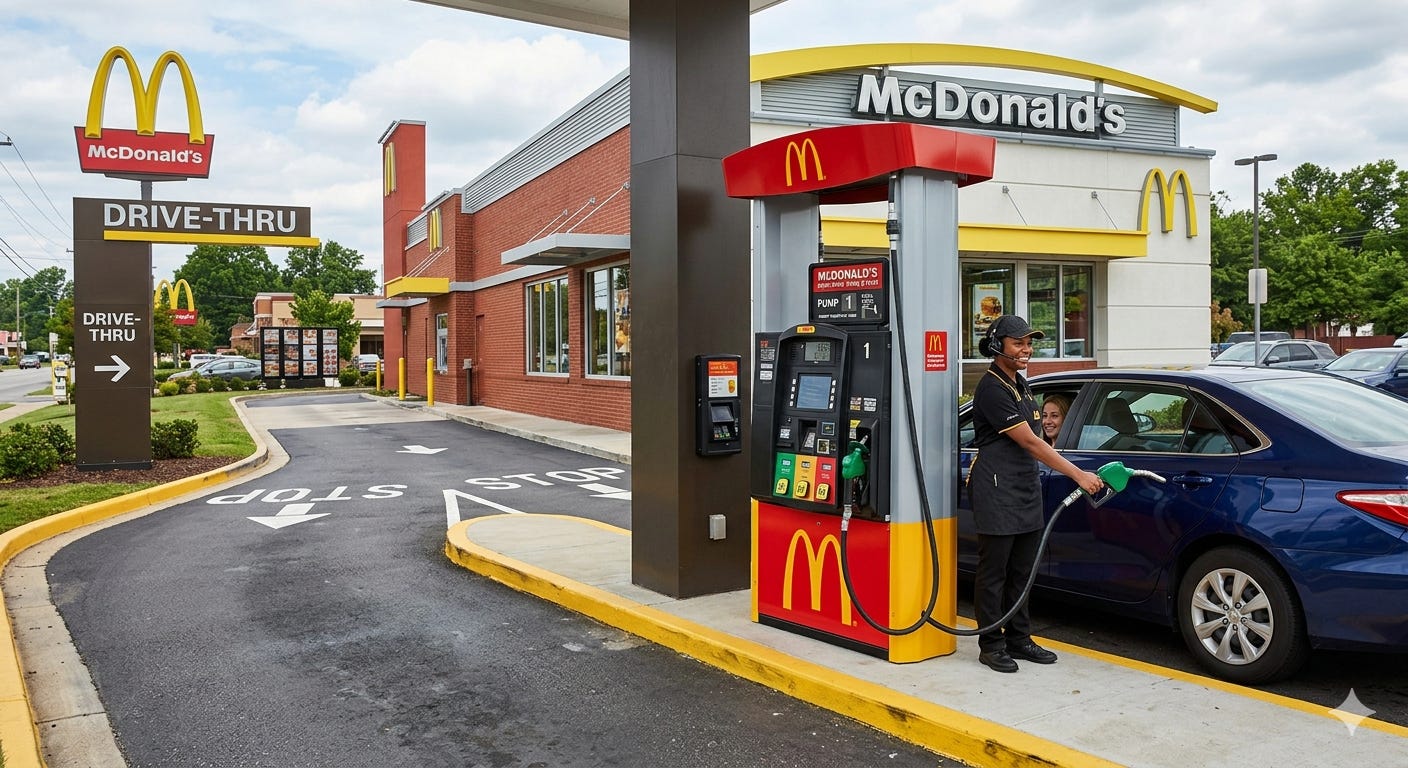
When I started writing this Substack, I didn’t intend for it to be exclusively about AI and the labor market. And yet, here we are; every day is something new on how AI is changing work and society. But every once in a while, I remember that there are other things going on as well; sometimes, I even write about them. Today is one of those days.
In a post about a month ago, I wrote that it was only a matter of time before the Federal Reserve makes the policy mistake of staying too tight into a supply shock.
[Alex Campbell] thinks the policy error the Fed is going to make is that they will still ease policy because of a weak labor market in the face of inflation, which will make inflation worse. I actually think they’re going to make the opposite mistake — I think they won’t ease because they just got burnt by Biden-era inflation even though this bout of potential inflation is clearly supply-driven. No amount of Fed easing can get more tankers through the Strait of Hormuz, so the net effect will be oil prices up, spending on non-oil things down, and therefore incomes down in the face of an already deteriorating labor market. That’s the recipe for falling demand, the one thing the Fed is set up to combat.
Now, there are some signs that this is beginning to happen.

This is the sort of demand destruction you would expect when a relatively non-discretionary spending item sees a supply-driven price increase. People still have to drive, but it costs more, so they cut back somewhere else. This may be inflation in a statistical sense — the price of something with a high weight in the index goes up — but it’s a relative inflation. The overall amount of money people have to spend does not change.
This is just a continuation of the great cost of living squeeze that has been happening since the post-pandemic stimulus. According to Gallup polling, the trajectory of Americans’ household financial situation peaked right before the pandemic and has been getting worse ever since.

But the Fed is still only concerned with the inflation part of the dual mandate:
Collins Backed FOMC Dissenters on Easing-Bias Language — Hawkish Coalition Broader Than 8-4 Vote Showed
Source: Bloomberg
Date/Time: Thu, 07 May 2026, 10:50 AM ET
Boston Fed President Susan Collins said she agreed with the three regional presidents — Logan, Kashkari, and Hammack — who dissented over the FOMC statement’s language implying the next rate move would be a cut. Collins supported changing the language but ultimately voted with the majority. The implication is significant: the anti-easing-bias coalition inside the FOMC is larger than the 8-4 vote disclosed. Four members formally dissented; at least one more agreed with them. The forward guidance toward cuts embedded in the May statement is now visibly hanging by a thin consensus, and any further deterioration in the inflation outlook — e.g., a deal not materializing and oil re-spiking — could flip the statement language entirely at the June meeting.
Goolsbee: Iran War Has Become an Inflationary Shock; Inflation Expectation Unanchoring Is “Extremely Problematic”
Source: Bloomberg / Reuters
Date/Time: Wed, 06 May 2026, 8:00 PM ET
Chicago Fed President Austan Goolsbee — a persistently dovish voice — explicitly characterized the US-Iran war as an inflationary shock, not yet stagflationary, but warned the distinction may not hold. “It has just been an inflationary shock. And the longer that continues, the more nervous that makes me.” His core concern is expectations unanchoring: if elevated oil prices persist long enough, the expectation of higher inflation embeds into wage demands and pricing behavior, making the shock self-fulfilling. Supply chain disruption is already layering additional goods inflation on top of energy. Goolsbee separately warned against cutting rates preemptively to chase productivity gains, noting war-driven inflation risks make that error costlier than usual. Paired with Collins backing the dissenters, these two May 6–7 Fed communications show that even the dovish wing of the FOMC is losing its willingness to overlook the war’s inflation channel.
The Fed is always fighting the last battle. In 2021, they were too easy in the face of massive fiscal stimulus because they were stuck in the post-GFC-decade-of-Secular-Stagnation mindset. Now, they’re stuck in an ‘inflation isn’t transitory’ mindset. Usually, fighting the last battle is understandable because a new crop of Fed governors come in who earned their stripes during the economic conditions that constitute the last battle, but this time around this is less so. This is because it’s still all the same people (for the most part). They were wrong on the way up and now they’re wrong on the way down and yet, to them, the biggest challenge is their independence from any oversight, not whether they are good at their jobs.
I, too, would like to be granted power over the economy with no accountability and no concern with whether I am doing well or not. It seems pretty clear to me that the economy is weakening and that the direction of travel is further weakness, not overheating.

News Scan
US and Iran Trade Fire Near Hormuz, Testing Ceasefire Framework
Source: Bloomberg / Al Jazeera / CNN
Date/Time: Fri, 08 May 2026
The Strait of Hormuz ceasefire came under its most severe test yet when US and Iranian forces exchanged fire on day 70 of the conflict. CENTCOM said its naval forces intercepted “unprovoked Iranian attacks” and responded with self-defence strikes, destroying several small boats and Iranian military facilities; Iran accused the US of targeting an oil tanker in coastal waters and striking civilian areas along its southern coast at Qeshm Island and Sirik. Three US destroyers transited the strait “under fire” without damage. Trump declared the ceasefire still in effect but issued an explicit threat: “we’ll knock them out a lot harder, and a lot more violently” if Iran doesn’t sign a deal fast. The episode establishes that the truce is a political designation, not a military reality — both sides are testing limits in real time. For the peace deal, the credibility of any MOU framework now hinges on whether this clash triggers a genuine commitment from Tehran, or whether Iran is calculating it can extract better terms through controlled escalation. Oil, gold, and safe havens should price in a materially wider distribution of outcomes for the Hormuz reopening timeline.
Al Jazeera
ECB’s Guindos Names Hormuz as the Gating Variable for June 10
Source: Bloomberg Economics
Date/Time: Fri, 08 May 2026, 7:37 AM
ECB Vice-President de Guindos gave the clearest articulation yet of the bank’s reaction function: “the status of Hormuz will be key for June.” He framed April as the observation window and June as the judgment window — a direct signal that June 10 is live for a decision, with the speed and extent of strait reopening as the trigger. The statement transforms every Hormuz update into an ECB pricing event. A sustained re-opening compresses the risk premium in energy and likely removes the justification for an emergency hike; a prolonged blockade or further military escalation — as in story #1 today — pushes the ECB into a forced choice between supply-shock leniency and wage-driven entrenched inflation. The German IP data and Eurozone PMI released the same day sharpen the dilemma: the ECB faces deteriorating growth at the same time it faces the highest food price index in three years. De Guindos’ statement is actionable because it names the variable, the timeline, and the decision point — what’s missing is the threshold, which markets will now try to extract from every subsequent ECB speaker.
Bloomberg
German Industrial Output Falls 0.7% in March — Second Consecutive Miss
Source: Bloomberg Markets / Destatis
Date/Time: Fri, 08 May 2026, 6:20 AM
German industrial production declined 0.7% in March versus a consensus expectation of +0.4%, marking the second consecutive monthly contraction. Energy generation fell 4.0% and mechanical engineering dropped 2.7%, partially offset by gains in autos (+1.9%) and construction (+1.9%). Year-on-year, output is down 2.8%. The data establishes that the Hormuz disruption is already transmitting through Europe’s industrial core: higher energy input costs and supply-chain disruptions are suppressing output even before any demand-side slowdown from consumer energy bills takes effect. For the ECB, this is the exact data pattern that makes June’s decision hard — inflation is still running above target due to commodity prices, but growth is contracting. The two consecutive misses in Germany undercut any narrative that the supply shock is being absorbed without GDP damage, and will weigh against the hawkish camp that argues the ECB should respond preemptively to energy-driven inflation. It also argues for the ECB’s “status of Hormuz” framing: if the blockade lifts, German IP rebounds; if it doesn’t, the region is heading for a mild recession concurrent with above-target inflation.
Bloomberg
Japan Intervenes Again as Yen Retops 160 — Markets Debate Treasury Sales
Source: Bloomberg Economics / Seoul Economic Daily
Date/Time: Fri, 08 May 2026
Japan launched a fresh 5 trillion yen ($32 billion) intervention on May 8 after USD/JPY broke through 160 again, the day after the Golden Week holiday period ended. Total interventions since April 30 now approach $70-100 billion across at least four separate operations. The new angle in the May 8 session is the debate over funding: Bloomberg reports that Fed custody holdings of Treasuries fell at a rate consistent with Japanese sales, raising the question of whether Tokyo is selling US government bonds to recycle dollars for yen purchases. If confirmed, this has a second-order effect on US bond markets — a large, price-insensitive seller working against the Fed’s own bond-market management. The yen continues to weaken despite the firepower deployed, because the rate differential (BOJ at 0.75%, Fed at 3.5-3.75%) is the structural driver, and intervention alone cannot close a 275bp gap. US Treasury Secretary Bessent meets BOJ Governor Ueda and PM Takaichi on May 12, with yen weakness explicitly on the agenda — the meeting outcome could shift this from unilateral intervention to coordinated pressure for faster BOJ rate normalization.
Bloomberg
Reform UK Seizes 367 Council Seats; Labour Routed; Starmer Declares He’ll Stay
Source: Bloomberg Markets / Irish Times / ITV
Date/Time: Fri, 08 May 2026
The UK local elections produced a historic fracturing of the two-party system: Reform UK gained 367 councillors (up from near zero) and seized control of Tameside, Wigan, and Salford — Labour strongholds for decades — while Labour lost 254 councillors and 8 councils. The Conservatives also declined. Nigel Farage declared “historic change.” Prime Minister Keir Starmer responded by stating he will not resign and will continue leading Labour. UK government bonds rallied on Starmer’s declaration, suggesting markets read leadership continuity as fiscal stability relative to an abrupt change that might have invited more pressure from the Reform wing on fiscal targets. The deeper implication is structural: Reform’s surge — built primarily on working-class ex-Labour voters — makes a near-term Conservative-Reform realignment plausible and puts pressure on Starmer to shift fiscal policy in a more populist direction to compete. If Labour loses the next general election to a Reform-influenced coalition, the fiscal framework underpinning UK debt sustainability could shift materially. The BOE’s already-complex task (inflation above target, growth slowing, political uncertainty rising) gets more complicated.
Bloomberg
Australia Budget to “Thread the Needle” Between War-Driven Inflation and Deficit Targets
Source: Bloomberg Economics
Date/Time: Fri, 08 May 2026, 12:10 AM
Australia’s Treasurer faces a structurally constrained budget environment: the Iran war has driven energy prices sharply higher, keeping headline inflation above target at a point where the RBA has already hiked three consecutive times to 4.35%. The government’s challenge is to avoid fiscal stimulus that adds to demand inflation while also avoiding excessive austerity that undercuts productivity investment and growth. The framing — “thread the needle” — signals the government is not planning either a significant stimulus nor a consolidation, but a neutral-ish budget under conditions of external energy shock. This matters for the RBA’s rate path: a neutral budget removes one source of demand pressure and keeps open the RBA’s “conditional pause” framing from the May MPC meeting, where Governor Bullock signaled potential pause contingent on data. If the budget comes in net-neutral to restrictive, it reduces the probability of a fourth consecutive RBA hike, and Australian rates and the AUD become more sensitive to Hormuz resolution (lower energy costs = RBA done sooner) versus a persistent energy shock (more hikes needed). Australia is one of the few DM economies simultaneously running both a current account deficit (first trade deficit in 8 years) and a rate-tightening cycle, making fiscal stance unusually important for external balance management.
Bloomberg
US Trade Court Strikes Down Trump’s 10% Global Tariffs — Second Ruling This Year
Source: Bloomberg / CNN / NPR
Date/Time: Thu, 07 May 2026
The Court of International Trade issued a 2-1 ruling declaring Trump’s 10% across-the-board global tariffs unlawful, finding that the administration misread Section 122 of the Trade Act of 1974 by equating trade deficits with balance-of-payments deficits — a conflation Congress explicitly did not make. This is the second judicial rejection of the tariff regime in 2026, following the Supreme Court’s earlier affirmation of a similar Trade Act ruling. The practical impact is constrained: the injunction applies only to two small businesses and Washington state (larger state coalitions were dismissed for lack of standing), and the tariffs are already scheduled to expire in late July. The administration is expected to appeal to the Federal Circuit and potentially the Supreme Court, meaning legal resolution is months away. The structural significance is larger: each successive ruling erodes the statutory foundation of executive tariff authority under emergency trade law, and a “Plan C” via Section 301 investigations is already underway. Companies face continued investment uncertainty, but the near-term tariff level for most importers is unchanged.
CNN
FAO Food Price Index Hits 3-Year High in April as Hormuz Disrupts Commodity Chains
Source: Bloomberg Markets / FAO
Date/Time: Fri, 08 May 2026, 8:00 AM
The FAO Food Price Index reached 130.7 in April — its highest since February 2023 and up 1.6% from a revised March level — driven by a 5.9% surge in vegetable oils and record-high meat prices. The vegetable oil spike reflects elevated energy costs raising biofuel demand and transport costs through Hormuz-adjacent shipping routes; the FAO chief economist explicitly cited energy pass-through as the mechanism. Cereal prices rose a modest 0.8% month-on-month, limiting the broader inflation footprint from grains, but the vegetable oil and meat acceleration means food CPI in EM economies — where food weight in CPI baskets runs 30-50% — will accelerate sharply in Q2. For DM central banks, this is a lagged but persistent secondary inflation transmission: food costs feed into services pricing (restaurants, catering) with a 3-6 month lag. The FAO data lands the same week the ECB is explicitly conditioning June on Hormuz status — the food price index is direct evidence that the energy shock is already broadening into agricultural commodity prices, making the ECB’s “wait for June” posture increasingly costly.
Bloomberg
Iran Opens China Rail Corridor to Bypass US Port Blockade
Source: Bloomberg Economics
Date/Time: Fri, 08 May 2026, 7:40 AM
Iran is routing trade through its rail connection to China as the US naval blockade cuts off maritime export channels, with volumes on the corridor expanding materially. The development has two implications: first, it reduces the effectiveness of the blockade as an economic pressure tool, since Iran can partially substitute Chinese demand for blocked seaborne exports; second, it deepens the Iran-China economic entanglement precisely as the US prepares to discuss China’s role in Iran’s energy supply at the Trump-Xi summit on May 14-15. China’s NFRA had quietly reversed its ban on bank lending to sanctioned Iranian refiners last week, and this rail expansion is the physical complement to that financial accommodation. The combined picture — Chinese banks financing Iranian oil, Chinese rail moving Iranian goods — complicates any peace deal that relies on economic isolation as leverage. The corridor also matters for the structural question of dollar hegemony: if Iran successfully routes meaningful trade through yuan-denominated channels with China, it adds to the evidence base that secondary sanctions have a declining marginal effectiveness against economies with strong Sino-Russian infrastructure alternatives.
Bloomberg
Disclaimer: The information provided on this blog is for informational purposes only and should not be considered investment, financial, or other professional advice. Nothing on this site constitutes a recommendation or solicitation to buy or sell any securities. You should consult with a qualified financial advisor before making any investment decisions. Investing involves risks, including loss of principal.