Regular readers know that I’m a big Michael Pettis fan, so when he shares an article — even one that I normally wouldn’t be interested in — I’m going to read it.
The article is about a newly popular genre in Chinese letters, workers’ literature.
Thanks for reading All In The Reflexes! Subscribe for free to receive new posts and support my work.
One might expect that a population raised on socialist ideals would not look kindly on excessive wealth. But when American and Chinese scholars conducted a series of surveys between 2004 and 2014, they found that Chinese people largely accepted the situation. All you needed to get ahead, survey participants responded, was talent, a good education and hard work. Others had already succeeded, but their day would come.
When the scholars repeated their research in 2023, however, the answers changed dramatically. Among the reasons given for why people are poor, “unequal opportunity” and “unfair economic system” had risen to the top. The population had lost the belief that effort and ability alone would get them where they wanted to go. With China’s decades of breakneck economic growth now in the past, the road ahead suddenly no longer looked to only be going up. The possibility of one’s life stagnating or backsliding looked more plausible than ever, and society’s ills loomed larger.
To better understand these ills, Chinese readers have turned to a once-niche genre of writing: workers’ literature (工人文学). Fiction, nonfiction and poetry written by and about the Chinese working classes have seen a surge of attention in recent years — online but also on the page. The past few years have seen a flurry of books published in China about life as a lower-class laborer — from delivering meals (赶时间的人, 2023), cleaning floors (我的母亲做保洁, 2023), driving taxis (我在上海开出租, 2024) or working in a factory (在工厂梦不到工厂, 2025).
Normally, I’d think this an interesting curio and move on with my life, but I think this social trend probably shows us the direction that our own society is going to move in the next few years.
An idea that I’m turning over is that, because of AI’s effect on the labor market, society is going to transform into something that could either be characterized as Technofeudalism or Technofascism, depending on how that transformation unfolds.
I talk about Technofeudalism enough on here that you probably already have a good idea of what it is, but I haven’t dwelt on Technofascism as much, so let’s go into it a bit.
In modern usage, fascism has taken on the meaning ‘things Democrats don’t like.’ Tariffs are fascist, country music when the singers don’t have face tattoos is fascist, Mitt Romney is fascist. But there is an actual, real definition of fascism:
The keystone of the Fascist doctrine is its conception of the State, of its essence, its functions, and its aims. For Fascism the State is absolute, individuals and groups relative. Individuals and groups are admissible in so far as they come within the State. Instead of directing the game and guiding the material and moral progress of the community, the liberal State restricts its activities to recording results. The Fascist State is wide awake and has a will of its own. For this reason it can be described as “ethica.”
That’s from Mussolini. By his conception, whereas in Liberalism the key unit of society is the individual, and in Socialism the key unit is the class, in Fascism the key unit is the state. This applies politically, but also economically.
The Fascist State lays claim to rule in the economic field no less than in others; it makes its action felt throughout the length and breadth of the country by means of its corporative, social, and educational institutions, and all the political, economic, and spiritual forces of the nation, organized in their respective associations, circulate within the State. A State based on millions of individuals who recognize its authority, feel its action, and are ready to serve its ends is not the tyrannical state of a mediaeval lordling. It has nothing in common with the despotic States existing prior to or subsequent to 1789. Far from crushing the individual, the Fascist State multiplies his energies, just as in a regiment a soldier is not diminished but multiplied by the number of his fellow soldiers.
The Fascist State organizes the nation, but it leaves the individual adequate elbow room. It has curtailed useless or harmful liberties while preserving those which are essential. In such matters the individual cannot be the judge, but the State only.
In fascist economics, activity is done not for the benefit of the shareholder, but for the benefit of the State. This does not necessarily mean that the State is the shareholder, just that the ultimate aim of the corporation is to serve the ends of the State; companies could be fully owned by individuals as long as the don’t run afoul of State goals.
This may all seem like a strange historical interlude, but it’s going somewhere, I promise. The reason I bring up this definition of fascism is because this society is not just a relic of history — it already exists. A society in which the individual and corporations are allowed free rein as long as that freedom ultimately serves the goal of the all-powerful State is the societal organization of current day China.
So far, we’ve just discussed Fascism, without touching the Techno. I think this part is more intuitive, though. If Fascism is where the State is the primary unit of society, Technofascism is the fusion of technology and the State in this primacy.
In a New Yorker piece from last year, the writer Kyle Chayka explored what he thought was the United States’s slide into Technofascism in the context of Elon Musk’s DOGE.
In the nineteen-thirties, Japan colonized Manchuria, in northeastern China, and the region became a test ground for techno-fascism. Nobusuke Kishi, a Japanese commerce-ministry bureaucrat, was appointed to head the industrial program in Manchuria, in 1936, and, with the collaboration of a new crop of the Japanese conglomerates known as zaibatsu, he instituted a policy of forced industrial development based on the exploitation of the local population. When Kishi returned to national politics in Japan, in 1939, along with a clique of other Japanese technocrats who had worked in Manchuria, he pursued similar strategies of state-dictated industrialization, at the expense of private interests and labor rights. This fascistic regime would not be structured the same way as Mussolini’s or Hitler’s, with power concentrated in the hands of a single charismatic leader, although Kishi had travelled to Germany in the nineteen-twenties, as the Nazi movement expanded, and drew inspiration from German industrialization for his Manchurian project. Instead, Mimura said, Japan “kind of slid into fascism” as bureaucrats exercised their authority behind the scenes, under the aegis of the Japanese emperor. As she explained, techno-fascist officials “acquire power by creating these supra-ministerial organs and agencies, subgroups within the bureaucracy that are unaccountable.” Today, Elon Musk’s DOGE is the Trumpian equivalent.
This sort of thing is not what I mean when I talk about Technofascism. If anything, this describes a souped-up version of our current state of affairs — managerial capitalism overseen by the professional-managerial class. The PMC is not going to run society in the age of AI, they are the ones who are being replaced by technology. Chayka gets it right that the big technologists think they’re going to be running society, but gets the method wrong. It’s not going to come through imposing Silicon Valley managerial techniques on the government, it’s going to come through replacing people with AI.
Bannon: Hang on, Andreessen and Musk are smart enough to be able to get below the surface on the numbers and see the direction of the country and climb on board as the technofeudalists early on.
They are hard-core technofeudalists. They’re not populist. I tease Elon all the time. If I could turn him from a technofeudalist globalist to a populist nationalist, we could make some progress here. He’s definitely a technofeudalist. One of the hardest-core technofeudalists. And so is Andreessen.
With these guys you’re talking about genius level intelligence. These are not dumb people. But they’re not with us when it comes to the little guy.
Douthat: But their view is connected to the argument you just made — which is that there’s a technological frontier. We are competing with China on a technological frontier.
Andreessen did not make a populist argument, but he made a nationalist argument. He said: Look, we want — and what the Trump administration has promised us — is for America to win, for our companies to win, for us to outcompete the Chinese and have what it takes to keep America ahead of the curve. Which we are at the moment.
I agree that DeepSeek, the Chinese A.I., raises a lot of questions about A.I. strategy —
Bannon: I don’t believe one [expletive] sentence of that. They don’t believe that. They don’t believe in this country. They believe in this country right now because it protects them and provides some benefits to them.
Remember, we bailed out these [expletive] on Silicon Valley Bank. Biden bailed them out when they couldn’t make payroll. They couldmake payroll if they put more of their own money in, but they wouldn’t. They had the little guy bail them out in the Silicon Valley Bank.
Now, in the last couple of days, what are they talking about? Oh, my gosh, we need a Marshall Plan. We need a space plan. We need a Mercury Plan. We need hundreds of billions of dollars from taxpayers.
They want essentially a bailout. If it’s a Sputnik moment, somebody’s got to ask the question: Yo, Andreessen! We made a deal with you guys. Elon, we made a deal with you guys. We made you oligarchs. We made you the richest people in the [expletive] history of the Earth. We stopped any antitrust.
This is what pisses me off the most. No antitrust, not breaking these companies up and allowing entrepreneurs to get in there. Marc Andreessen doesn’t believe in the entrepreneurial system in the country. No way!
Douthat: I don’t know. Just to defend prior guests on this program as a matter of policy, I think there is a big difference between how the big social media companies regarded themselves and how the venture capital world regarded itself.
I’m not going to look into anybody’s soul and think about whether they believe in America —
Bannon: Ross. Ross.
Douthat: But they do believe they believe in a different form of competition than does Google, Facebook and so on. And I think that’s why they’ve always been more sympathetic to the right.
Bannon: Hang on. I’m not saying Andreessen’s a bad guy at the heart of it. But their America is an idea.
America’s not an idea! It’s not. It’s a country with a border and a group of citizens that’s the greatest resource we’ve ever had.
And the apartheid state of Silicon Valley thinks we don’t need our greatest resource, which is the American citizen. They’d rather import basically indentured servants to work for a third less and have an apartheid state. And then as soon as they can replace them with digital serfs, they will do it.
The Big Tech oligarchs think that they are going to be the ones running society because they are the ones that control AI. But as I’ve written before:
Sam Altman, Dario, OpenAI, Anthropic, all these guys think they are the ones pulling the strings. But they’re not. How many divisions does Sam Altman have?2
OpenAI is mooting a $1 Trillion IPO, but if the cost of OpenAI existing—cost in the disruption of society—is too high, it’s going to be a zero because the government is going to take it. They’re either going to nationalize it or co-opt it to fund the same technofeudalist program OpenAI proposes they do.
The big AI labs need to start giving back to society in a big way before society turns against them.
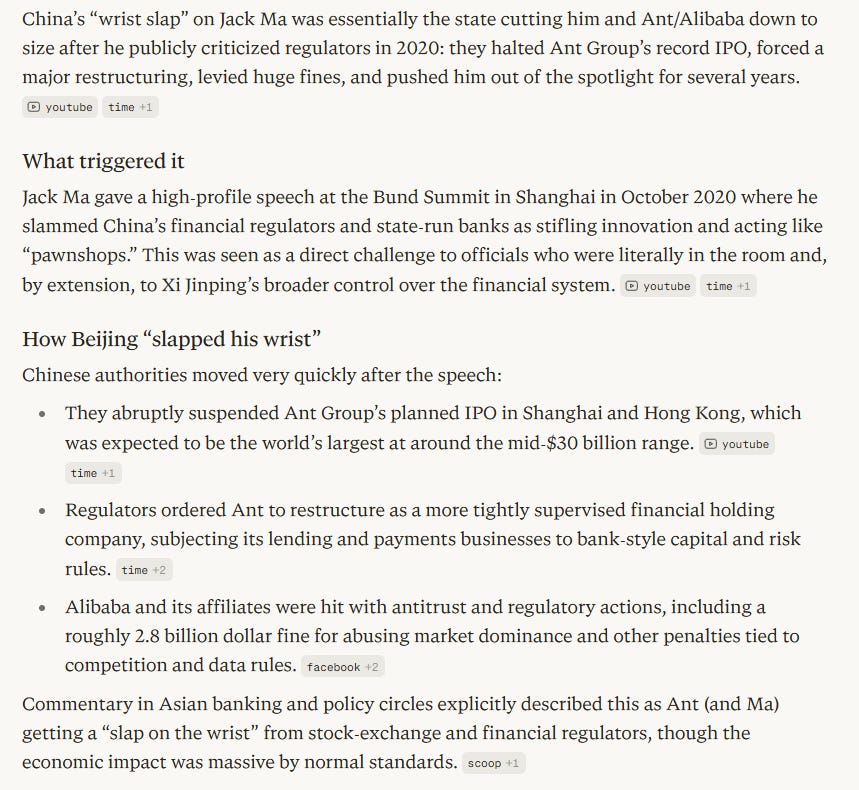
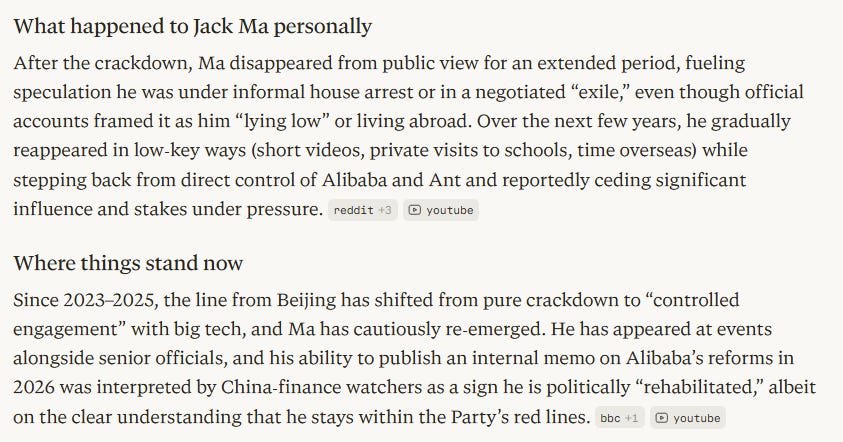
There is precedent for this sort of thing, coming from the Technofeudalist bellwether China.
The United States is not going to let Sam, Dario, Elon, and Andreesen run the country. At some point — and it already happened once with Elon — they are going to get cut down to size. They may still get to run their companies, but only if those companies are serving the ends of the State. That’s how it works in Fascism. That’s how it works in China.
In Chayka’s account, the same thing happened to the earlier iteration of the Technofasicsts in Japan.
Techno-fascism’s cold-blooded pursuit of efficiency quickly results in a state of alienation that may not be appealing to either side of the political spectrum. If Japan is any example, the collaboration between technocrats and right-wing politicians is unlikely to last forever. In 1940, the Japanese Prime Minister announced the New Order movement, which sought to overhaul the government’s structure to create a single-party state with absolute power. Mimura, the historian, said, “It reminds you a little bit of now: everything needs to be fixed, all at once. It is a little eerie to draw that historical comparison: this is the New Order in America.” Yet the power of Japan’s technocrats began to wane. When the country started faring poorly in the war, the military pushed to continue the campaign past the point that technocrats considered feasible. Kishi, the architect of technocratic Manchuria, left the government in 1944.
And while the State aims of Technofascist China may be being fulfilled, for the citizens that don’t have a place in the commanding heights of the economy, it’s not really that great of a deal.
Both Hu Anyan’s and Xiao Hai’s books — their literary resumes of itinerant employment — provide a sobering insight into China’s economy. In 2010, China outstripped Japan as the world’s second-largest economy. Its ability to manufacture everything from cheap trinkets to industry-leading high-tech remains an object of global envy. From a top-down view, the Chinese economy looks set for many more years of success. But seen from below, through the eyes of these two writers, the inescapable conclusion is that China boomed in part because it provided no better prospects to its migrant workers than struggling through one low-paid job after another. China runs on hundreds of millions of Hu Anyans and Xiao Hais, but their share of the country’s riches has been meager. They toiled away during decades of unprecedented progress but have little to show for it. It was a time, Xiao Hai writes, “when everyone was riding the tide of China’s economic growth — except for us blue-collar workers.”
The prospects for change aren’t promising. China’s economy, while growing and producing more than it can consume, is failing to create enough stable jobs. Its construction and education industries no longer employ as many people as they once did. Manufacturing is increasingly being done by robots. As a result, parcel delivery, ride-hailing and other gig work is on the rise, as the Wall Street Journal recently reported. Such an increase in competition is likely to make this work even less secure.
This is the future that awaits us when AI takes all the jobs. Either Sam Altman and Marc Andreesen throw the serfs some scraps each year on Ada Lovelace’s birthday or the US will become the most powerful empire known to man while all of its citizens work as home health aides to wipe each others’ butts.
The only other option will be creating TikToks about life as a home health aide, at least until those get taken over by AI slop.
News Scan
Iran Deal Framework “Largely Negotiated,” Then US Strikes Complicate Hormuz Timeline
Source: CNN, CBS News, Times of Israel, ABC News, Al Jazeera Date/Time: May 23–26, 2026 The US and Iran moved from tentative ceasefire toward a documented framework to end the war and reopen the Strait of Hormuz — but fresh US military action on May 25 introduced new uncertainty about timing and terms. On May 23, Trump declared the deal “has been largely negotiated” and that Hormuz would reopen “soon”; oil dropped sharply. The framework structure leaked May 24: a 60-day ceasefire extension during which Iran de-mines the Strait and drops toll enforcement; in exchange, the US lifts its naval blockade and issues targeted sanctions waivers for Iranian oil exports. A second 60-day phase would open nuclear negotiations on a “relief-for-performance” basis. The first Japanese tanker to traverse Hormuz since the conflict began arrived in Japan the same day. Then on May 25, the US military conducted “self-defense strikes” on Iranian missile launch sites and patrol boats near the Strait while the ceasefire nominally remained in force. Oil immediately rebounded. Rubio walked back the timeline, saying talks were hung up on “a word, a sentence”: Iran insists on language categorically prohibiting Israeli military operations in Lebanon; Israel has pushed Washington to preserve that option; Iran rejects the formulation. Asset-unfreezing mechanics and nuclear enrichment timelines also remain unresolved. An Iranian delegation relocated to Qatar for continued talks. Trump: “time is on our side.” The deal pathway is real and documented, but the Lebanon clause introduces a wildcard — any breakdown on Israeli military prerogatives could derail an agreement that otherwise appears close to final. CNN live updates
Source: Bloomberg, American Banker, Federal Reserve Board Date/Time: May 22–25, 2026 Federal Reserve Governor Christopher Waller — delivering the first significant Fed communication since Kevin Warsh became Chair — pivoted hawkish in a Frankfurt speech on May 22. Waller said he supports removing the “easing bias” language from the Fed’s policy statement at the June 16–17 FOMC meeting, making it explicit that a rate cut is no more likely than a rate increase. More significantly, he said inflation is “not headed in the right direction” and that he “can no longer rule out rate hikes further down the road” if inflation fails to abate or inflation expectations become unanchored. The Fed’s preferred PCE measure hit 3.8% in April; the Cleveland Fed now projects 4.18% for May. Waller stopped short of advocating near-term hikes — the labor market is stable but not booming at 4.3% unemployment — but futures markets immediately moved to price ~67% probability of a 25bp hike at the October FOMC. The June FOMC is now framed as a language-shift event: stripping the easing bias and establishing a neutral stance will itself register as a hawkish signal, even without a rate change. On May 25, Bloomberg noted a key Treasury yield spread narrowed to its tightest level in a year under Warsh. The 30-year Treasury at 5.17% and Warsh’s AI “disinflationary force” thesis are in direct conflict with a bond market pricing structural deficits and persistent energy-driven inflation. Warsh inherits a committee that’s already pivoted hawkish (four dissenters at the April meeting) and a curve pricing an extended period of elevated rates regardless of his cut preferences. Federal Reserve Board
ECB: Schnabel Says June Hike “Will Be Needed” Even If Iran Deal Struck; ECB Baseline Includes Two Hikes
Source: Bloomberg, RTE, ActionForex, ECB Date/Time: May 26, 2026 ECB Executive Board member Isabel Schnabel — potential successor to President Lagarde — delivered the clearest signal yet that the June 11 hike has passed a point of no return. “From today’s perspective, I think a rate hike in June will be needed,” Schnabel told Reuters, explicitly stating that even a ceasefire wouldn’t change the calculus: “even if the war ended today, a lot of damage has already been done to energy infrastructure and global supply chains.” Second-round effects are “materializing,” she said, citing the ECB’s Consumer Expectations Survey, PMI data, and the EU Commission sentiment indicator. “Given the size and the persistence of the current shock, looking through is no longer an option.” Crucially, Schnabel revealed that the ECB’s own baseline projection includes two rate hikes — not one — suggesting June is the beginning of a tightening sequence rather than a one-and-done move. On the same day, Chief Economist Philip Lane told Nikkei that the ECB “will probably raise its quarterly inflation projection next month due to elevated energy prices.” EZ headline CPI recently hit 3.0% with further increases expected. Together, Schnabel’s point-of-no-return commitment and Lane’s forward guidance on the upward inflation revision effectively eliminate any ECB dovish optionality for June and raise the question of whether July or September delivers the second move. Bloomberg
French Power Prices Surge as Extreme Heat Threatens Nuclear Curtailment — New European Inflation Leg
Source: Bloomberg Date/Time: May 26, 2026 French electricity prices surged on May 26 as extreme summer heat raised fears that nuclear facilities would need to curtail output — adding a new domestic supply-side driver to the energy inflation already pushing the ECB toward its June hike. France generates roughly 70% of its electricity from nuclear reactors, many of which rely on river-water cooling; sustained high temperatures reduce cooling capacity and can force reactor shutdowns, as happened during the 2022 and 2023 European heat waves. The risk is not hypothetical — curtailments can materialize within weeks once river temperatures exceed operating thresholds. The timing directly feeds the ECB’s June decision. Lane already signaled the ECB will raise its inflation projection at the June 11 meeting (story #3); nuclear curtailment risk adds a domestic supply-side driver absent from prior ECB forecasts. If French output is curtailed through July–August, European natural gas demand spikes as backup generation ramps, driving continental gas prices higher and reinforcing the second-round effects Schnabel says are materializing. Unlike geopolitical oil spikes — which tend to fade — domestic nuclear curtailment is a structural seasonal constraint that intensifies as summer heat worsens, making it a sticky, forecast-period inflation contributor rather than a temporary spike. Bloomberg
BOJ Deputy Governor Himino: “Appropriate Policy” Key to Market Confidence as JGB Yields Hit 30-Year Highs
Source: Bloomberg, Japan Times Date/Time: May 26, 2026 BOJ Deputy Governor Ryozo Himino delivered the BOJ’s clearest public acknowledgment yet of the JGB selloff’s systemic risk: “it is important to maintain market confidence that inflation will be appropriately controlled by adjusting the degree of monetary easing at an appropriate pace in response to future economic, price, and financial conditions.” The statement reads as implicit guidance that the BOJ is monitoring the long end and is prepared to accelerate rate action to prevent a disorderly yield spiral. The backdrop: Japan’s 10-year JGB yield sits at ~2.78%, its highest level in roughly 30 years; the 20-year yield touched 3.555%, a historic high. The BOJ’s board is no longer unified — three members dissented at the April meeting calling for rates to rise immediately to 1.00%, signaling impatience with the current pace. Market swaps price a 77% probability of a BOJ rate hike at the June meeting. The financial stability dimension is acute: Nippon Life recorded its first impairment loss on JGB holdings in the current cycle (~¥3.6T in unrealized losses, ¥500bn realized), and Japan’s major life insurers collectively face roughly ¥9T ($60bn) in unrealized JGB losses. As impairment thresholds are breached, these institutions will moderate JGB purchases — a reflexive loop in which yield rises force insurer balance-sheet adjustment, which further reduces JGB demand, which accelerates yield rises. Himino’s statement is partly aimed at capping this dynamic. Bloomberg
Japan: Takaichi’s $19bn Extra Budget Funds Energy Subsidies Without New Bond Issuance; Debt Costs Hit 29-Year High
Source: CNBC, Japan Times, Bloomberg Date/Time: May 25, 2026 Prime Minister Sanae Takaichi announced a ¥3T ($19bn) supplementary budget to fund utility assistance in response to the Iran energy shock, funded from reserves and stronger tax revenues without additional bond issuance. Total bond issuance will remain unchanged from the original plan, as stronger tax revenues and expected underspending eliminate ~¥3T in previously scheduled deficit bonds. The structural context is sobering. Debt-servicing costs in the FY2026 general account jumped 10.8% to ¥31.3T, with the budget using an assumed interest rate of 3.0% — the highest assumption in 29 years. The fiscal discipline signal is real but creates a widening secondary problem: the energy subsidies are directly expanding the gap between administered/subsidized electricity and gas prices vs. market prices. Every quarter that subsidies remain in place, the pent-up price adjustment grows. When subsidies eventually expire or are reduced — as fiscal constraints will eventually force — the catch-up move will flow through to Japan’s CPI in a single-quarter spike. The BOJ’s ability to “read through” government price controls is therefore shrinking as the controlled-price footprint grows and the latent inflation risk accumulates. CNBC
Nippon Life Books First JGB Impairment Loss; Japan Life Insurers Face $60bn in Bond Losses
Source: Bloomberg, Insurance Business Magazine Date/Time: May 26, 2026 Nippon Life — Japan’s largest life insurer — recorded its first impairment loss on government bond holdings in the current rate-hiking cycle, acknowledging approximately ¥3.6T ($25bn) in unrealized losses and ¥500bn in realized losses. Japan’s major life insurers collectively face roughly ¥9T ($60bn) in unrealized JGB losses, concentrated in long-duration bonds. The company indicated it will moderate JGB acquisitions going forward, shifting toward foreign assets. The macro significance: life insurers are the dominant structural buyer of Japan’s long-duration government bonds. As impairment thresholds are breached and capital constraints tighten, these institutions reduce JGB purchases, removing a critical marginal buyer from the market at precisely the moment the BOJ is hiking rates. The reflexive loop runs: BOJ hikes → yields rise → insurer unrealized losses mount → impairment thresholds breached → insurers cut JGB demand → yields rise further. The scale is material — ¥9T in aggregate unrealized losses across the sector now constrains institutional behavior regardless of forward policy. This directly complicates the BOJ’s desire to normalize policy gradually without triggering a disorderly JGB selloff. Bloomberg
Samsung’s $26.6bn Chip Bonus Triggers BOK Inflation and Housing Risk Warning
Source: Bloomberg Economics, SamMobile Date/Time: May 21–26, 2026 Samsung Electronics reached a last-minute union agreement on May 21, averting a strike and agreeing to distribute approximately 40 trillion won ($26.6bn) in bonuses to its semiconductor division — an average of ~$340,000 per chip worker. Bloomberg Economics flagged on May 26 that AI chip profits are being directly converted into household liquidity on a massive scale, creating demand-side inflationary pressure for South Korean housing markets and consumer spending at precisely the moment the Bank of Korea is hiking rates to contain energy-driven supply-side inflation. The transmission mechanism is unusually direct and concentrated: Samsung’s AI boom (operating profits estimated to multiply ~7x to 330 trillion won in 2026) flows immediately into personal consumption and real estate at scale. The BOK has been hiking into a supply shock; it may now face a simultaneous demand shock from within its own flagship exporter. Bonuses tied to operating profit at Samsung and SK Hynix are evolving from firm-level labor agreements into a broader macroeconomic channel — funneling chip-sector profits into household liquidity, asset prices, and wage expectations. The BOK’s terminal rate calculus must now factor in not just energy-driven CPI but an AI-driven demand surge that could sustain core inflation well beyond the energy shock’s resolution. Bloomberg
India: Fourth Fuel Price Hike in Ten Days as Rupee Hits Record Low ₹92.47/$
Source: Bloomberg, IndMoney, Discovery Alert Date/Time: May 25, 2026 India’s state fuel retailers raised petrol and diesel prices for the fourth time in ten days, pushing petrol above ₹100/litre in Delhi for the first time. The rupee simultaneously fell to a record low of approximately ₹92.47/USD, compounding import costs. India’s wholesale price index is expected to approach 9% in May as war-driven crude prices feed through to transportation, manufacturing, and agricultural costs; retail CPI (3.48% in April) is expected to accelerate sharply in coming months as sequential fuel pass-throughs hit consumer budgets. India is now the clearest G20 template of EM stagflation: a supply-driven inflation shock (oil) compounding with currency depreciation to force sequential price pass-throughs, while growth faces headwinds from higher input costs and weakening consumer purchasing power. The RBI faces the classic EM central bank dilemma — cut rates to support growth and rupee-sensitive debtors, or hold/hike to defend the currency and anchor inflation expectations. The record rupee low and the pace of fuel hikes suggest markets are not confident the RBI has a comfortable path. As India escalates monetary tightening signals to defend the rupee, EM capital flows and regional currency pressures intensify — reinforcing the broader divergence story the Iran war is generating across emerging markets. Bloomberg
Aluminum Hits Four-Year High on China Structural Cap and Middle East Energy Squeeze
Source: Bloomberg, ING Think Date/Time: May 26, 2026 Aluminum prices reached $3,676/T on May 26, the highest since March 2022, driven by the convergence of China’s hard 45-million-tonne production cap and energy disruptions from the Iran war forcing curtailments at energy-intensive global smelters. China produces roughly 60% of global aluminum output but is constrained by a government-imposed structural ceiling with no remaining capacity headroom. Middle East energy disruption is raising smelter operating costs globally and forcing output cuts at marginal producers. A global aluminum deficit of ~200kt is projected for 2026, with demand supported by EV battery systems, renewable energy infrastructure, and aerospace manufacturing — sectors with low substitution capacity. The price signal extends beyond the metal itself: aluminum is a broad input cost indicator for global manufacturing supply chains. A sustained move above $3,500/T adds directly to corporate costs across automotive, construction, and durable goods sectors, contributing to the “prices-up, output-soft” stagflationary configuration now visible across multiple hard-data indicators. Combined with the French nuclear power story (elevated European electricity prices), this reinforces the picture of a global economy facing simultaneous energy, metals, and food commodity cost shocks that are embedding into the cost structures of real-sector firms. Bloomberg
Disclaimer: The information provided on this blog is for informational purposes only and should not be considered investment, financial, or other professional advice. Nothing on this site constitutes a recommendation or solicitation to buy or sell any securities. You should consult with a qualified financial advisor before making any investment decisions. Investing involves risks, including loss of principal.
Thanks for reading All In The Reflexes! Subscribe for free to receive new posts and support my work.